
Is It Safe to Drive Your Own Car to Char Dham? A Real Risk Analysis
By Zubair · 28 Jul 2026 · 133 reads
Quick Answer
Yes — driving your own car on Char Dham is safe in the right season, with the right driver and a prepared vehicle. The risks are concentrated and predictable: brake fade on descents, landslides on the Dharasu–Uttarkashi stretch in monsoon, and driver fatigue on the three legs that run nine hours or more. Avoid July and early August entirely, allow 10–12 days rather than 7, and hire a hill-trained driver. Do these three things and the trip is no more dangerous than any mountain drive.
Key Takeaways
- Season decides most of the risk. May–June and September–October are safe; July–early August is not.
- Brake fade is the top mechanical risk — prevented entirely by engine braking.
- The Dharasu–Uttarkashi gorge is the single riskiest section.
- Fatigue is the top human risk — three legs run 9+ hours.
- 7-day itineraries are unsafe — allow 10–12 days.
- An SUV is safer than a sedan on the rougher sections.
- Build 3 spare days for closures on fixed-date bookings.
The question is usually asked by someone who has heard a story about a landslide or a brake failure on the yatra route, and wants to know whether it is a genuine risk or an exaggerated one. It is genuine — but it is also highly concentrated. Almost every serious incident on this circuit comes from one of three specific causes, and all three are avoidable with decisions made before the trip begins.
The Three Real Risks
| Risk | Where It Happens | How It Is Prevented |
|---|---|---|
| Brake fade on descents | Any sustained gradient, especially Janki Chatti to Barkot | Engine braking — change down before the descent, footbrake in short bursts only |
| Landslides | Dharasu to Uttarkashi gorge, July–early August | Travel outside monsoon; never drive during or after heavy rain; allow spare days |
| Driver fatigue | The three legs running 9+ hours | Allow 10–12 days; hire a driver so nobody in the family is driving |
Notice what is not on this list: the road surface, the gradient itself, or the altitude. These are manageable. The three above are what actually cause problems.
Risk by Month
| Month | Landslide Risk | Road Condition | Overall Safety |
|---|---|---|---|
| Late April | Low | Snow on high sections, otherwise good | Good |
| May | Low | Good, heavy traffic | Good |
| June | Low–moderate | Good, peak traffic | Good |
| July | High | Frequent closures | Avoid |
| Early August | High | Frequent closures | Avoid |
| Mid-August–September | Moderate, falling | Improving | Good |
| October | Low | Best of the year | Best |
| November | Low | Good until temples close | Good |
Eight months of the year this circuit is a safe, well-maintained mountain drive. Four to six weeks of it are genuinely hazardous, and almost every bad story comes from that window.
The Dharasu–Uttarkashi Stretch
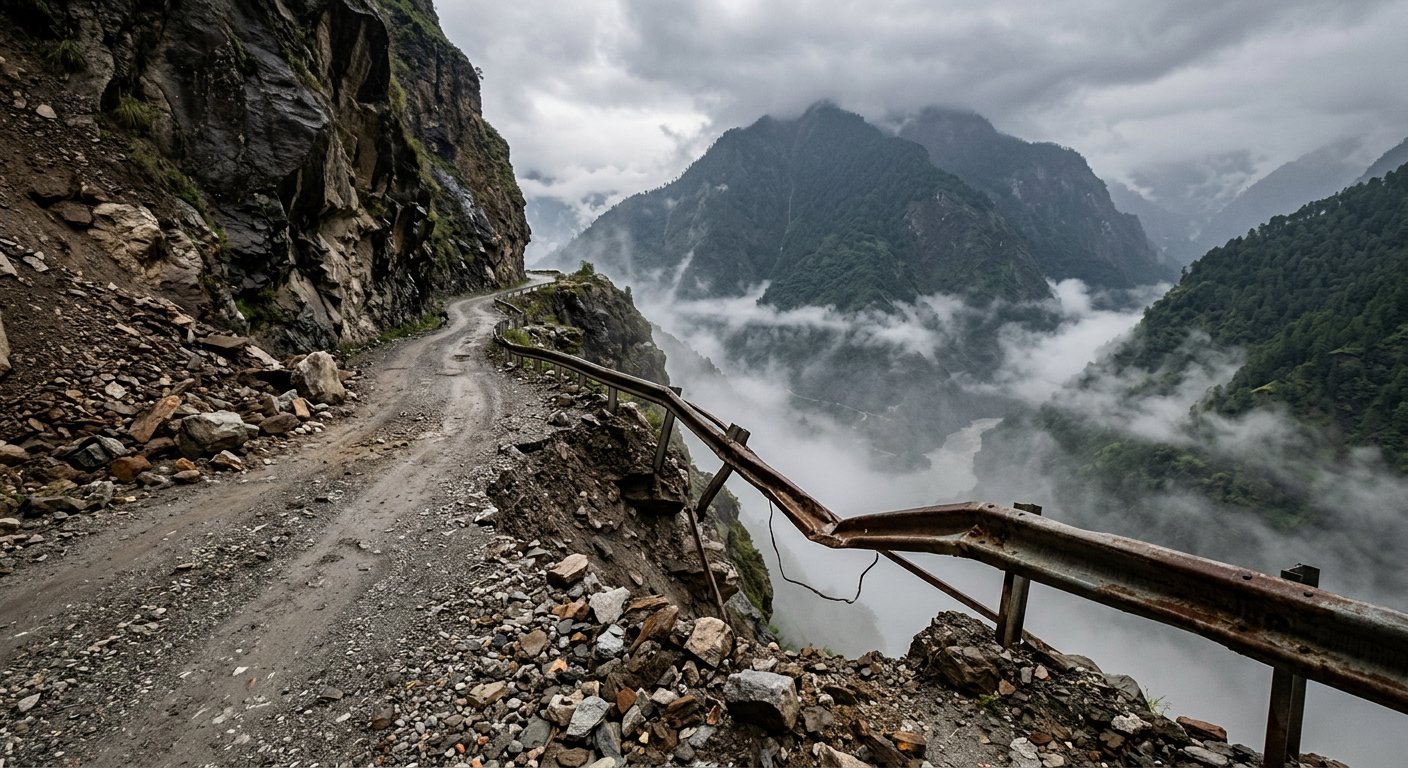
This is the section people have usually heard about. It runs along a river gorge on a road carved into the cliff face, with frequent landslide debris, loose rock and sections where the carriageway has partially collapsed and been temporarily restored.
- Do not drive it during or immediately after heavy rain.
- Never stop beneath an exposed slope. Keep moving through and stop only in designated wide areas.
- Travel in the right season. May–June or September–October. Never July or early August.
- Allow 10–12 days. Do not compress the itinerary. Fatigue is the top human risk.
- Build in 3 spare days. For closures on fixed-date bookings, especially on the Dharasu stretch.
- Cross risky sections in daylight. Never attempt the gorge sections after dark.
- Change down before every descent. Engine braking, not the footbrake, holds the speed.
- Stop if brakes feel soft. Fifteen minutes of cooling restores normal function. Continuing is what turns a scare into an accident.
- Hire a hill-trained driver. He is the redundancy if anyone in the family falls ill at altitude.
Why 7-Day Itineraries Are Unsafe
| Itinerary | Average Driving Day | Risk Level |
|---|---|---|
| 7 days | 8–10 hours, 5 days running | High — fatigue is the top cause of incidents |
| 10 days | 6–8 hours, with recovery days | Moderate |
| 11–12 days | 5–7 hours, proper rest | Low |
The circuit does not compress. The distances are fixed and the average speeds are low because the roads are single-lane with hairpin bends. Cutting two days out of the itinerary does not save time — it converts a manageable trip into a fatigued one.
Driving Yourself vs Hiring a Driver
| Factor | Driving Yourself | Hiring a Hill-Trained Driver |
|---|---|---|
| Gradient technique | Only if you know engine braking | Trained and assessed on it |
| Fatigue | You drive 6–9 hours daily for 10+ days | You rest |
| Altitude effect | Reduced concentration above 3,000 m | Accustomed to it |
| Landslide judgement | Unfamiliar | Knows which stretches block and when |
| If you fall ill | Nobody else can drive the family out | He can |
| Cost | No driver charge | ₹1,799/day, 5-day minimum |
The fifth row is the one that decides it for most families. On a ten-day trip at altitude, if the only qualified driver becomes unwell, there is no way out. A hired driver is not a luxury — he is the redundancy.
Vehicle Safety Checks
| Check | Requirement | Consequence If Skipped |
|---|---|---|
| Brake pads | Above 60% thickness | Brake fade on the first major descent |
| Tyre age | Under 4 years regardless of tread | Hardened rubber loses grip on cold wet surfaces |
| Coolant and hoses | Fresh, no cracks | Overheating on sustained climbs |
| Heater and demister | Working | Fogged windscreen above 3,000 m |
| Spare wheel | Serviceable | Nearest workshop can be 100 km away |
| Insurance | Valid for all states entered | No cover in an incident |
The full checklist, including transmission-specific checks for automatic cars, is in the automatic car checklist.
Practical Safety Rules for the Circuit
Driving Char Dham Safely
Frequently Asked Questions
Is it safe to drive your own car to Char Dham?
Yes, in the right season with a hill-trained driver and a prepared vehicle. The risks are concentrated in three specific causes — brake fade on descents, monsoon landslides on the Dharasu–Uttarkashi stretch, and driver fatigue on the three legs running nine hours or more. All three are avoidable.
Which month is most dangerous for Char Dham?
July and early August. Monsoon landslides repeatedly close the Yamunotri and Gangotri roads in this window. Eight months of the year the circuit is a safe mountain drive; these four to six weeks are genuinely hazardous.
Which section of the route is riskiest?
Dharasu to Uttarkashi. It runs along a river gorge on a road carved into the cliff face with frequent landslide debris. Do not drive it during or after heavy rain, never stop beneath an exposed slope, and cross it only in daylight.
Why are 7-day Char Dham itineraries unsafe?
They mean eight to ten hour driving days for five days running. The circuit cannot be compressed — distances are fixed and average speeds are low. Fatigue is the top human cause of incidents on this route.
Should I drive myself or hire a driver?
Hire one. Beyond the gradient technique and landslide judgement, a hired driver is the redundancy if the only qualified driver in the family becomes unwell at altitude — and on a ten-day trip that is a real possibility.
Is a sedan safe for Char Dham?
It will complete the circuit but an SUV with good ground clearance is safer and considerably more comfortable, particularly on the rougher sections between Guptkashi and Sonprayag and on any temporary track restored after a landslide.
What vehicle checks are essential?
Brake pads above 60% thickness, tyres under four years old with at least 3 mm tread, fresh coolant with sound hoses, a working heater and demister, a serviceable spare wheel, and insurance valid for all the states you will enter.
How many spare days should I allow?
Three, on any fixed-date booking. The Dharasu stretch closes regularly after heavy rain even outside peak monsoon, and there is no alternative route for most of the circuit.
Char Dham safely, in your own car
Hill-trained police-verified drivers. ₹1,799/day, 5-day minimum, live location sharing.
More guides.
Trusted Driver Service in Dehradun: How to Verify Before You Book
The five checkable things a genuinely accountable driver service will show you before you book, the questions that expose a weak one, the red flags that should end the conversation, and what accountability looks like on a bad day.
Driver Service Price in Dehradun: Hourly vs Monthly vs Outstation
All three driver pricing models side by side — on-demand, monthly and outstation — with the full rate card, the 25-day crossover point that decides which is cheaper for you, and every additional charge listed.
Safe Driver Service for Senior Citizens in Dehradun: What It Includes
What a proper senior citizen driver service actually includes — patient driving, door-to-door assistance, waiting through appointments, safety protocols, the rates, and how families living in other cities manage the arrangement.
Need a driver right now?
Call or WhatsApp — a verified Pahadi driver for your own car reaches you in minutes. Fixed fare, 24×7.