
Char Dham Yatra in Your Own Car: Should You Hire a Hill Driver?
Pahadi Driver Service · 28 Jul 2026 · 76 reads
Quick Answer
Driving your own car on Char Dham is possible and popular, but only with a hill-trained driver. The circuit covers roughly 1,600–1,800 km over 10–12 days, with sustained gradients, single-lane stretches and landslide-prone sections between Dharasu and Uttarkashi. A driver costs ₹1,799 per day with a 5-day minimum, plus ₹500 per night for night duty, ₹300 per day food allowance, and accommodation arranged by you. You pay fuel, toll and parking.
Key Takeaways
- 1,600–1,800 km over 10–12 days — the standard full circuit.
- ₹1,799 per day, minimum 5 days, for a hill-trained driver in your own car.
- +₹500 per night for night driving or extra duty; ₹300 per day food allowance.
- Best window: May to June and September to October.
- Avoid July–early August — landslides repeatedly close the Yamunotri and Gangotri roads.
- The Dharasu–Uttarkashi stretch is the single riskiest section of the circuit.
- Engine braking is non-negotiable — brake fade on these gradients has no shoulder to stop on.
Char Dham in your own car gives you something a package tour cannot: your own schedule, your own stops, your own seats and your own medicines in the boot. It also puts you on some of the most demanding roads in India for ten consecutive days, which is precisely why the driver question matters more here than on any other trip.
This guide covers whether to drive yourself or hire, the route, the costs, and the specific risks that decide the answer.
Should You Drive Yourself or Hire?
| Factor | Driving Yourself | Hiring a Hill-Trained Driver |
|---|---|---|
| Cost | No driver charge | ₹1,799/day, 5-day minimum |
| Fatigue | You drive 6–9 hours daily for 10+ days | You rest; he drives |
| Gradient technique | Only if you know engine braking | Trained and assessed on it |
| Altitude effect | Reduced concentration above 3,000 m | Accustomed to it |
| Landslide judgement | Unfamiliar | Knows which stretches block and when |
| Family safety | You are the only qualified driver | Someone else is always available |
| Enjoyment | You see the road, not the mountains | You actually see the Himalayas |
The last row is the one people forget. On a ten-day circuit through some of the most spectacular mountain scenery in India, the person driving sees the road. Hiring a driver is not only a safety decision — it changes what the trip actually is.
The Circuit at a Glance
| Leg | Route | Distance | Driving Time |
|---|---|---|---|
| 1 | Dehradun → Barkot | ~180 km | 7–8 hours |
| 2 | Barkot → Yamunotri (Janki Chatti) → Barkot | ~90 km + trek | 6–7 hours |
| 3 | Barkot → Uttarkashi | ~110 km | 5–6 hours |
| 4 | Uttarkashi → Gangotri → Uttarkashi | ~200 km | 8–9 hours |
| 5 | Uttarkashi → Guptkashi / Sitapur | ~220 km | 9–10 hours |
| 6 | Guptkashi → Kedarnath (Sonprayag) → Guptkashi | ~120 km + trek | Full day |
| 7 | Guptkashi → Pipalkoti / Joshimath | ~180 km | 7–8 hours |
| 8 | Joshimath → Badrinath → Joshimath | ~90 km | 5–6 hours |
| 9 | Joshimath → Rishikesh / Dehradun | ~250 km | 9–10 hours |
Two of these legs are genuinely hard: Uttarkashi to Guptkashi, and Joshimath back to Rishikesh. Both involve eight hours or more of continuous gradient driving on single-lane sections.
The Riskiest Section: Dharasu to Uttarkashi
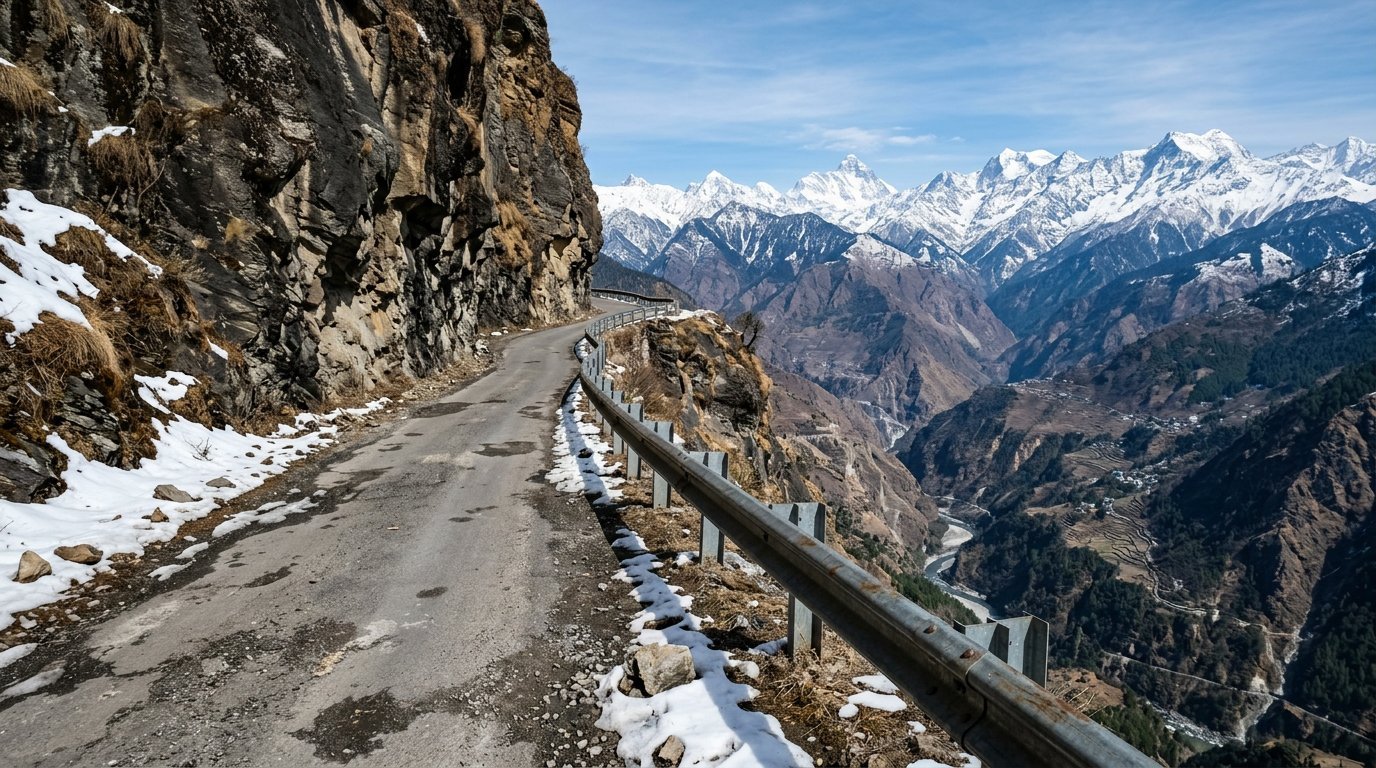
This stretch runs along a river gorge on a road carved into the cliff face, with frequent landslide debris, loose rock and sections where the carriageway has partially collapsed and been temporarily restored. It is the section most often closed after heavy rain.
- Do not drive it during or immediately after heavy rain.
- Never stop beneath an exposed slope — keep moving through, and stop only in designated wide areas.
- Watch for fresh debris. Mud and small rocks on the carriageway indicate recent movement above.
When to Go
| Period | Conditions | Verdict |
|---|---|---|
| May–June | Yatra season peak, roads open, clear weather, heavy crowds | Best, book early |
| July–early August | Monsoon landslides, repeated closures | Avoid |
| Mid-August–September | Rain easing, crowds thinner, lush scenery | Good |
| September–October | Clearest weather, thinner crowds, cold nights | Best overall |
| November | Temples begin closing (Diwali period) | Final window |
| December–April | Temples closed, roads snowbound | Not possible |
What a Driver Costs on the Circuit
| Item | Amount | Notes |
|---|---|---|
| Driver charge | ₹1,799 per day | Minimum 5 days |
| Night driving or extra duty | ₹500 per night | |
| Food allowance | ₹300 per day | Standard outstation rate |
| Driver accommodation | Arranged by you, or reimbursed at actuals | Budget ₹800–₹1,500 per night |
| Fuel | Actuals | Roughly ₹12,000–₹15,000 for the full circuit |
| Toll and parking | Actuals | |
| Difficult route surcharge | ₹200–₹300 per day | Applies on this circuit |
For a 11-day circuit, driver-related cost is roughly ₹34,000–₹40,000 including food, accommodation and surcharges. Fuel and toll are additional.
Vehicle Preparation Before the Circuit
| Check | Requirement |
|---|---|
| Brake pads | Replace if under 60% — mountain descent consumes far more than city driving |
| Tyre age | Replace anything over 4 years regardless of tread; hardened rubber loses grip on cold wet surfaces |
| Tyre tread | Minimum 3 mm |
| Coolant and hoses | Full, no cracks — sustained climbing at altitude stresses the cooling system |
| Engine oil | Fresh, correct grade for high altitude |
| Spare wheel and jack | Present, inflated, accessible |
| Heater and demister | Working — essential above 3,000 m |
An SUV with good ground clearance is strongly preferable. A sedan will complete the circuit but suffers on the rougher stretches between Guptkashi and Sonprayag.
Why a Hill-Trained Driver Specifically
The skills that matter on this circuit are specific and are not acquired through city driving: engine braking on sustained descents, brake-fade recognition, blind-bend discipline, monsoon landslide judgement and fog procedure. The full test — four questions you can ask in two minutes — is in the experienced hill driver guide.
For month-by-month detail on crowds, weather and road conditions, see Char Dham best time guide.
Frequently Asked Questions
Should I hire a driver for Char Dham in my own car?
Yes, strongly. The circuit covers 1,600–1,800 km over 10–12 days with sustained gradients and landslide-prone sections. A hill-trained driver costs ₹1,799 per day with a five-day minimum, and removes both the fatigue and the gradient-technique risk.
How much does a driver cost for the full Char Dham circuit?
₹1,799 per day with a five-day minimum, plus ₹500 per night for night duty, ₹300 per day food allowance, ₹200–₹300 per day difficult-route surcharge, and accommodation you arrange. For 11 days this totals roughly ₹34,000–₹40,000 before fuel and toll.
What is the best time to do Char Dham in your own car?
May to June for the peak season with all roads open, or September to October for the clearest weather and thinner crowds. Avoid July and early August entirely — monsoon landslides repeatedly close the Yamunotri and Gangotri roads.
Which section of the Char Dham route is most dangerous?
Dharasu to Uttarkashi. It runs along a river gorge on a road carved into the cliff face with frequent landslide debris. Do not drive it during or after heavy rain, never stop beneath an exposed slope, and allow three spare days for closures.
Can I complete Char Dham in a sedan?
Yes, but an SUV with good ground clearance is strongly preferable. A sedan will manage but suffers on the rougher stretches between Guptkashi and Sonprayag.
What vehicle checks are essential before the circuit?
Brake pads above 60% thickness, tyres under four years old with at least 3 mm tread, full coolant with sound hoses, fresh engine oil, a working spare wheel, and a functioning heater and demister for altitudes above 3,000 metres.
How many days does the full circuit take?
Ten to twelve days is the comfortable standard. Rushing it into seven or eight days means eight-hour driving days on single-lane mountain roads, which is the most common cause of fatigue-related problems on the circuit.
Do I need to arrange the driver's accommodation?
Yes. You either arrange it or reimburse at actuals — budget ₹800–₹1,500 per night. This is standard on all outstation trips in the region.
Do Char Dham in your own car, safely
Hill-trained, police-verified drivers. ₹1,799 per day, 5-day minimum, live location sharing.
More guides.
Car Driver Salary in Dehradun 2026: Real Pay by Hours & Experience
Real car driver salary bands in Dehradun for 2026 by duty hours and capability, what actually moves a driver from ₹18,000 to ₹32,000, how the city compares with Delhi NCR and Mumbai, and the extras that form part of every package.
How to Hire a Verified Driver in Dehradun: 2026 Safety Checklist
A practical 2026 checklist for hiring a driver for your own car in Dehradun — which documents to verify, how to confirm genuine hill-route experience, what rates are fair, and the red flags that separate a verified service from an unverified one.
Jolly Grant Airport (DED) Guide: Distance, Timing & Transfer Costs
Everything about Jolly Grant Airport (DED) for travellers — distance and driving time from Dehradun, Mussoorie, Rishikesh and Haridwar, what a transfer costs, the night charge, and the two journeys that most often cause missed flights.
Need a driver right now?
Call or WhatsApp — a verified Pahadi driver for your own car reaches you in minutes. Fixed fare, 24×7.