
Char Dham Yatra Best Time to Go & Why a Local Driver Matters
By Zubair · 30 Jul 2026 · 132 reads
Quick Answer
The best time for Char Dham Yatra is late April to early June and September to mid-November. May and June offer stable weather but the heaviest crowds; July and early August bring monsoon landslide risk on the Yamunotri and Gangotri stretches; September and October give clear skies, thinner crowds and comfortable driving. The circuit takes 9 to 11 days and a hill-trained driver costs ₹1,799 per day with a five-day minimum.
Key Takeaways
- Best overall: late April–early June, and September–mid-November.
- Most crowded: May and June, especially around Akshaya Tritiya and school holidays.
- Highest risk: July to early August — monsoon landslides close the Yamunotri and Gangotri roads repeatedly.
- Best for clear mountain views: late September to October, after the monsoon clears.
- Circuit length: approximately 1,600 km over 9–11 days.
- Driver cost: ₹1,799/day, five-day minimum. Food and stay for the driver are provided by you.
- Non-negotiable: a driver who has completed the circuit in the current season.
Char Dham Yatra timing is one of those decisions where the difference between a good month and a bad one is not comfort — it is whether you complete the yatra at all. The circuit crosses four high-altitude shrines connected by roads that close for landslides, snow and maintenance on a schedule nobody fully controls.
This guide gives the month-by-month reality, the standard route, and the driving considerations that decide whether a family's yatra goes smoothly.
Char Dham Yatra Month by Month (2026)
| Period | Weather | Crowds | Road Risk | Verdict |
|---|---|---|---|---|
| Late April | Cool, 8–22°C at altitude | Low | Moderate — residual snow patches | Excellent — shrines just opened, roads quiet |
| May | Pleasant, 12–26°C | Very high | Low | Good weather, worst crowds |
| June | Warm, 15–28°C | Very high | Low | Peak season, book everything early |
| July | Monsoon onset | Moderate | High — landslides | Avoid if timing is flexible |
| Early August | Heavy monsoon | Low | Very high | Highest closure risk of the year |
| Late August | Monsoon receding | Low–moderate | Moderate–high | Improving, still unsettled |
| September | Clear, 10–24°C | Moderate | Low | Excellent — clear views, good roads |
| October | Cool, 6–20°C | Moderate | Low | Best overall balance |
| Early November | Cold, 2–15°C | Low | Moderate — early snow possible | Good, but shrines close mid-November |
Why July and August Are the Risky Window
The Yamunotri and Gangotri roads run along river valleys where the monsoon destabilises slopes that were already fragile. In a typical monsoon season, sections between Dharasu and Uttarkashi, and between Barkot and Yamunotri, close repeatedly for periods of one to five days.
A yatra planned tightly through this window can lose three days to a single closure. Pilgrims with fixed leave and return flights are the ones who suffer most. If your dates fall in July or August, build in three spare days and keep your return travel flexible.
The Standard 9 to 11 Day Route
The Classic Char Dham Circuit from Dehradun
- Day 1 — Dehradun to Barkot (approx. 210 km). Via Mussoorie and Chinyalisaur. Overnight at Barkot, the base for Yamunotri.
- Day 2 — Yamunotri darshan. Drive to Janki Chatti, then a 6 km trek or pony ride to the shrine. Return to Barkot.
- Day 3 — Barkot to Uttarkashi (approx. 100 km). Along the Bhagirathi valley. Overnight at Uttarkashi.
- Day 4 — Gangotri darshan. Drive to Gangotri, darshan, return to Uttarkashi for the night.
- Day 5 — Uttarkashi to Guptkashi or Sitapur (approx. 220 km). The longest driving day of the circuit, via Tehri and Rudraprayag.
- Day 6 — Kedarnath darshan. Drive to Sonprayag, then Gaurikund. The final 16 km is on foot, pony or helicopter. Overnight at Guptkashi.
- Day 7 — Guptkashi to Badrinath via Chopta (approx. 200 km). Via Joshimath. Overnight at Badrinath or Pandukeshwar.
- Day 8 — Badrinath darshan, then to Rudraprayag or Joshimath. Darshan in the morning, then begin the descent.
- Day 9–10 — Return to Dehradun (approx. 320 km). Usually split across two days via Rishikesh.
The clockwise order above — Yamunotri, Gangotri, Kedarnath, Badrinath — is the traditional sequence and also the one that manages altitude gain most sensibly.
Real Cost of a Char Dham Yatra in Your Own Car
| Cost Head | 10-Day Estimate |
|---|---|
| Driver charge (₹1,799/day × 10) | ₹17,990 |
| Fuel (approx. 1,600 km) | ₹14,000–₹16,000 |
| Driver food (₹300/day) and accommodation | ₹6,000–₹8,000 |
| Toll, parking and permits | ₹1,500–₹2,500 |
| Your family's hotels and meals | ₹18,000–₹35,000 |
| Approximate total | ₹57,000–₹79,000 |
A hired Innova Crysta for the same circuit typically runs ₹55,000–₹70,000 for the vehicle alone. The full arithmetic is in own car driver vs taxi in Dehradun.
Why Hill-Route Experience Is Non-Negotiable
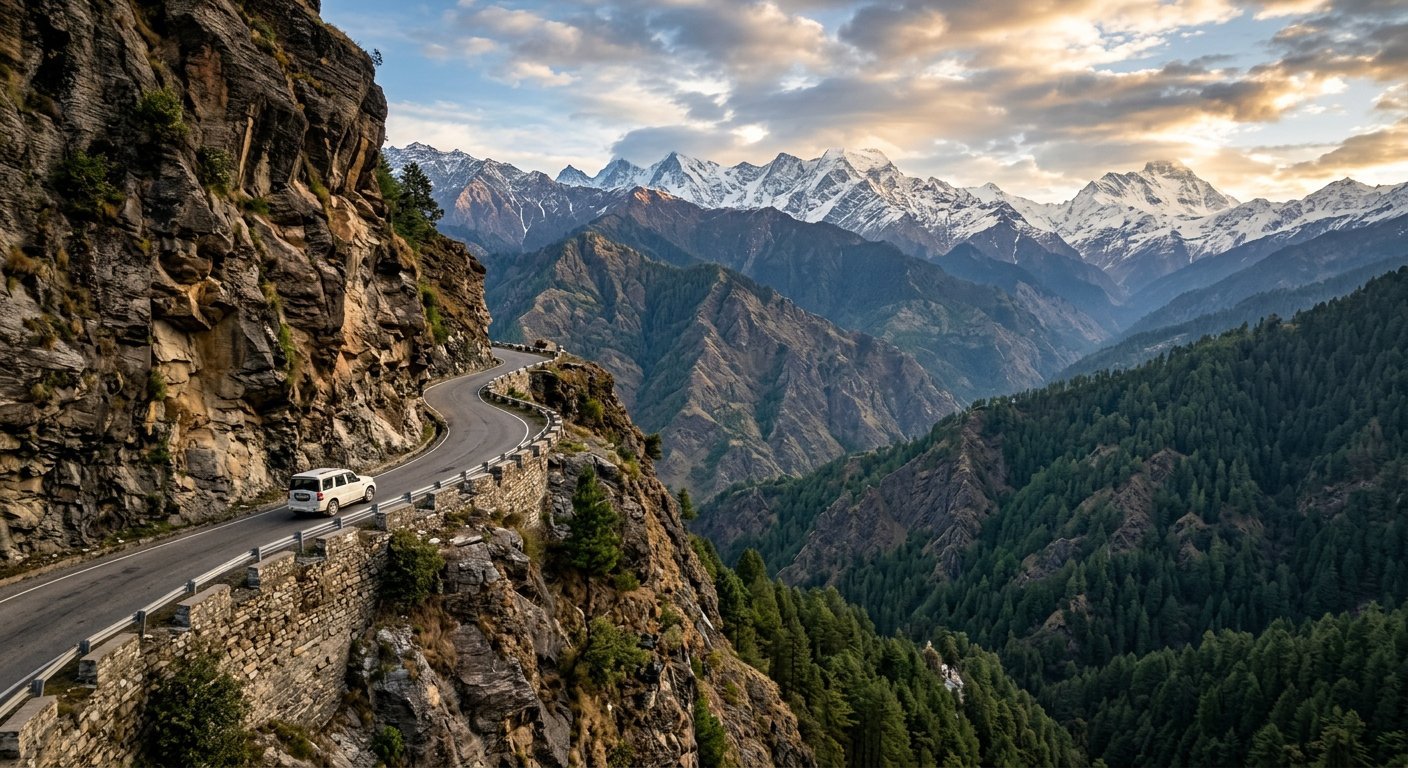
The Char Dham circuit is not long-distance driving. It is 1,600 kilometres of continuous gradient work on roads that are frequently 6 metres wide with an unprotected drop. Three specific skills separate a hill driver from a plains driver here:
- Engine braking on descent. Riding the footbrake down a 20 km gradient causes fade. The correct technique is a low gear and intermittent braking.
- One-way traffic windows. Several stretches operate time-boxed one-way movement. A driver who knows the schedule saves hours; one who does not will sit in a queue.
- Reading the road surface after rain. Fresh landslide debris, water across the carriageway and soft shoulders are all common, and each requires a different response.
Ask any prospective driver which stretches he has driven this season and how he descends a long gradient. Specific answers — Chinyalisaur, Bhairon Ghati, Lambgaon — indicate real experience. Vague answers do not.
Vehicle Preparation Before the Circuit
- Brake pads — replace if under 50% thickness. Mountain descent consumes brakes faster than 5,000 km of city driving.
- Tyres — replace anything over four years old regardless of tread. Rubber hardens and grip on wet mountain surfaces drops sharply.
- Coolant and hoses — sustained climbing at altitude stresses the cooling system.
- Spare wheel and jack — a puncture between Uttarkashi and Gangotri means a long wait without one.
- Confirm your insurance permits a paid driver. Most Indian private-car policies do, but some require an endorsement.
Frequently Asked Questions
What is the best time for Char Dham Yatra?
Late April to early June, and September to mid-November. October offers the best balance of clear weather, manageable crowds and low road risk. May and June have the best weather but the heaviest crowds.
When should I avoid Char Dham Yatra?
July and early August. Monsoon landslides repeatedly close the Yamunotri and Gangotri roads during this window, sometimes for one to five days at a time. If you must travel then, keep three spare days.
How many days does Char Dham Yatra take?
The standard circuit from Dehradun takes 9 to 11 days covering approximately 1,600 km. A rushed 7-day version is possible but leaves almost no margin for weather or road closures.
How much does a driver cost for Char Dham Yatra?
₹1,799 per day with a five-day minimum, so a 10-day yatra costs about ₹17,990 in driver fees. Food and accommodation for the driver are provided by the customer.
Can I take my own car for Char Dham Yatra?
Yes, and it is usually cheaper than hiring a taxi. A 10-day yatra in your own car with a driver costs roughly ₹38,000–₹42,000 excluding your family's hotels and meals, against ₹55,000–₹70,000 for a hired Innova Crysta.
Is it safe to drive to Kedarnath and Badrinath?
Yes, with a hill-trained driver who has completed the circuit in the current season, a well-maintained vehicle and dates outside the peak monsoon. Road conditions change every year after the rains.
What is the traditional order of the four dhams?
Yamunotri, Gangotri, Kedarnath, then Badrinath. This clockwise sequence is both the traditional order and the one that manages altitude gain most sensibly.
When do the Char Dham shrines close?
Typically around Diwali in early to mid-November, with exact dates announced each year by the respective temple committees. Yamunotri and Gangotri close first.
Planning your Char Dham Yatra?
Hill-trained drivers who have run the circuit this season. Published rate ₹1,799/day.
More guides.
Part Time Driver Earning in Dehradun: Realistic 2026 Numbers
What part-time driving actually pays in Dehradun — per-shift rates, which work earns the most per hour, realistic monthly scenarios, and the step-by-step path from one morning school run to ₹30,000 a month.
Driver Service Price in Dehradun: Hourly vs Monthly vs Outstation
All three driver pricing models side by side — on-demand, monthly and outstation — with the full rate card, the 25-day crossover point that decides which is cheaper for you, and every additional charge listed.
Trusted Driver Service in Dehradun: How to Verify Before You Book
The five checkable things a genuinely accountable driver service will show you before you book, the questions that expose a weak one, the red flags that should end the conversation, and what accountability looks like on a bad day.
Need a driver right now?
Call or WhatsApp — a verified Pahadi driver for your own car reaches you in minutes. Fixed fare, 24×7.