
Safe Driving Tips for Uttarakhand Hills: The Complete 2026 Guide
By Zubair · 28 Jul 2026 · 138 reads
Quick Answer
The five rules that prevent most hill-driving accidents in Uttarakhand: use engine braking on descents instead of riding the footbrake, never overtake on a blind bend, stay left and sound the horn before every hairpin, drive with headlights on even in daylight, and stop immediately if the brakes feel soft or spongy. Most hill accidents in Uttarakhand involve brake fade on descent or overtaking on a blind curve — both entirely avoidable.
Key Takeaways
- Engine braking is the single most important technique — a low gear, not the footbrake, controls descent speed.
- Brake fade is the top cause of hill accidents: continuous braking overheats pads until they stop gripping.
- Never overtake on a blind bend. Oncoming trucks are common and there is no room to recover.
- Headlights on, always. Fog and shaded bends appear without warning on ridge roads.
- Horn before blind hairpins — it is expected practice, not discourtesy, in the hills.
- Soft or spongy pedal = stop now. Let the brakes cool for 15 minutes before continuing.
- Monsoon (July–August) multiplies landslide risk on the Yamunotri and Gangotri roads.
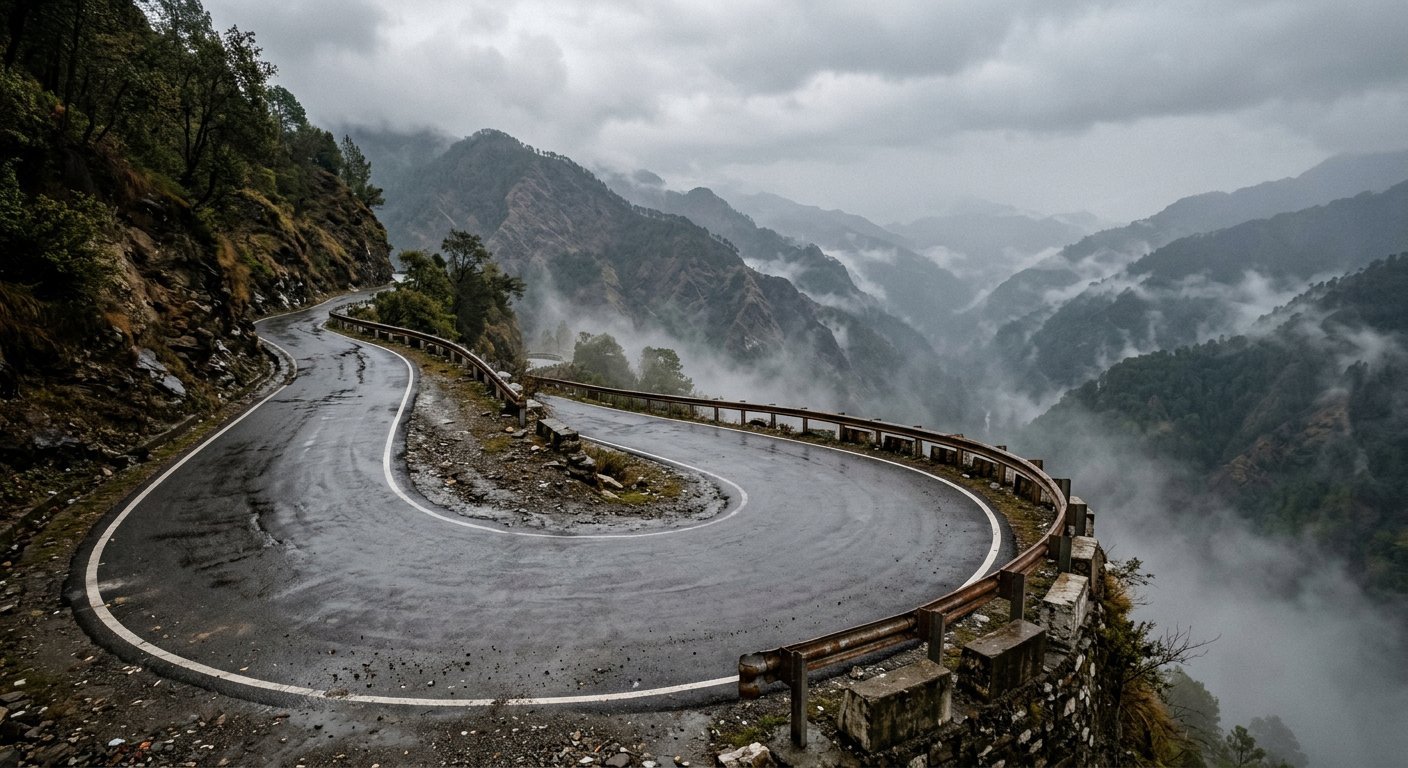
Uttarakhand's roads are not difficult because they are narrow. They are difficult because a single mistake has no margin. A misjudged overtake on the Dehradun–Mussoorie road, or brakes that fade halfway down from Dhanaulti, do not end in a dent — they end badly. Yet almost every serious accident on these roads comes from one of about six repeated errors.
This guide covers those errors, the techniques that prevent them, and what to check on the vehicle before it climbs.
The Six Errors Behind Most Hill Accidents
| Error | Why It Happens | What To Do Instead |
|---|---|---|
| Riding the footbrake downhill | Drivers brake continuously out of caution | Select a low gear before the descent and let engine braking hold speed |
| Overtaking on a blind bend | A slow vehicle ahead feels unbearable | Wait. Passing places appear every few hundred metres |
| Entering a hairpin too fast | The bend is tighter than it looks from above | Slow before the bend, not during it. Brake on the straight |
| Driving without headlights in fog | Daylight feels sufficient | Low beam on at all times on ridge roads, especially after 3 PM in winter |
| Ignoring a soft brake pedal | Drivers assume it will recover | Stop immediately and let the brakes cool for 15 minutes |
| Overloading with roof cargo | Family luggage on a yatra | Roof loads raise the centre of gravity dangerously on cambered roads |
Engine Braking: The Technique That Matters Most
On a long descent, a loaded vehicle can build enough speed to overwhelm its brakes in under two kilometres of continuous braking. The pads heat past their working range, the friction coefficient drops sharply, and the pedal goes to the floor. This is brake fade, and it is the most common mechanical cause of hill accidents.
Engine braking prevents it entirely. Before starting a descent, select the gear you would need to climb the same gradient — second or third in a manual, L or 2 in an automatic. The engine's compression then holds the vehicle's speed, and the footbrake is used only in short, deliberate applications.
Descending a Long Hill Gradient Correctly
- Change down before the descent starts. Do it on the flat section at the top, while you still have full braking available.
- Select the gear you would need to climb it. Usually second or third in a manual; L, 2 or S in an automatic.
- Let engine compression hold the speed. The engine note will rise. That is correct and is what is doing the work.
- Use the footbrake in short bursts only. Two to three seconds at a time, then release. This keeps the pads in their working temperature range.
- Watch for the warning signs. A brake smell, a pedal that travels further than usual, or a fading hiss means stop immediately.
- If brakes feel soft, stop and wait. Fifteen minutes of cooling restores normal function. Continuing is what turns a scare into an accident.
Overtaking and Blind Bends
Uttarakhand's hill roads are mostly single-lane each way with no shoulder. Overtaking is only safe where you can see the road ahead for at least 150 metres — which on these roads means designated passing places and occasional straights.
Two habits save lives here. First, sound the horn before every blind hairpin; it is standard practice and other drivers expect it. Second, never assume a bend is clear because nothing is visible — loaded trucks descend these roads at speed and appear suddenly.
Fog, Rain and Visibility
Ridge roads between Chamba and Dhanaulti, and the Bhairon Ghati stretch, can drop to near-zero visibility within minutes, particularly after 3 PM between November and February. Three rules apply:
- Low beam, not high beam. High beam reflects off fog and reduces your own visibility.
- Follow the road edge, not the vehicle ahead. Tail-lights in fog lead drivers off the carriageway.
- Reduce speed to what you can stop within sight distance. If you can see 30 metres, drive so you can stop in 30 metres.
Monsoon: The Highest-Risk Window
Between July and early August, the Yamunotri and Gangotri roads experience repeated landslides. Fresh debris on the carriageway, water running across the road and softened shoulders are all common.
If you must travel in this window: avoid driving during or immediately after heavy rain, never stop beneath an exposed slope, cross water flowing over the road only if it is below axle height, and build three spare days into any fixed-date itinerary.
Vehicle Checks Before Any Hill Trip
| Check | What To Look For | Why It Matters |
|---|---|---|
| Brake pads | Replace if under 50% thickness | Mountain descent consumes far more brake than city driving |
| Tyre age | Replace anything over 4 years old regardless of tread | Rubber hardens; grip on cold wet surfaces drops sharply |
| Tyre tread | Minimum 3 mm for hill work | Below that, water cannot clear and aquaplaning risk rises |
| Coolant level and hoses | Full, no cracks or swelling | Sustained climbing at altitude stresses the cooling system |
| Engine oil | Correct grade, recent change | Hot running and gradient load degrade oil faster |
| Spare wheel and jack | Present, inflated, accessible | A puncture between Uttarkashi and Gangotri means a long wait |
| Wipers and washer fluid | Working, full | Sudden hill showers are common year-round |
Automatic Cars in the Hills
Most automatics sold in India lack a proper manual mode, which makes long descents harder. If your car has L, 2 or S, use it. If it does not, brake in very short bursts and stop to cool more often than you would in a manual. Never let an automatic coast in Drive down a sustained gradient — the transmission will upshift and the vehicle will accelerate.
If you are hiring a driver for an automatic, confirm he has driven automatics on hill routes before. The technique is genuinely different. See what to verify in the automatic car driver checklist.
Frequently Asked Questions
What is the most important hill driving technique?
Engine braking on descents. Select a low gear before the descent starts and let engine compression hold the vehicle's speed, using the footbrake only in short two-to-three-second bursts. This prevents the brake fade that causes most hill accidents.
What causes brake fade on hills?
Continuous braking on a long descent overheats the pads past their working temperature, and friction drops sharply until the pedal goes to the floor. A loaded vehicle can reach this point in under two kilometres of continuous braking.
What should I do if my brakes feel soft on a descent?
Stop immediately in a safe place and let the brakes cool for fifteen minutes. Continuing is what turns a warning into an accident. A brake smell or a pedal that travels further than usual are the early signs.
Is it safe to drive in Uttarakhand during monsoon?
It requires caution. July and early August bring repeated landslides on the Yamunotri and Gangotri roads. Avoid driving during or after heavy rain, never stop beneath an exposed slope, and build spare days into fixed-date trips.
Should I use high beam in hill fog?
No. High beam reflects off fog and reduces your own visibility. Use low beam, follow the road edge rather than the tail-lights of the vehicle ahead, and reduce speed so you can stop within your sight distance.
Can automatic cars handle Uttarakhand hill roads?
Yes, if the driver uses L, 2 or S mode on descents. Never let an automatic coast in Drive down a sustained gradient — it will upshift and accelerate. If the car has no manual mode, brake in very short bursts and cool more often.
What should I check on my car before a hill trip?
Brake pad thickness, tyre tread and tyre age (replace anything over four years old), coolant level, engine oil, wipers and the spare wheel. Tyre age matters more than tread — hardened rubber loses grip on cold wet mountain surfaces.
Why should I sound the horn on hill bends?
It is standard practice in the Himalayas and other drivers expect it. Blind hairpins hide oncoming loaded trucks, and a short horn before the bend is the only warning you can give.
Not confident on hill roads?
Our drivers are hill-tested and run these routes weekly. Police-verified, published rates.
More guides.
Part Time Driver Earning in Dehradun: Realistic 2026 Numbers
What part-time driving actually pays in Dehradun — per-shift rates, which work earns the most per hour, realistic monthly scenarios, and the step-by-step path from one morning school run to ₹30,000 a month.
Driver Police Verification in Dehradun: Full Process, Documents & Timeline
The full driver police verification process in Uttarakhand — which police station to approach, the documents required, why it takes 7 to 21 days, how to recognise a genuine acknowledgement, and why annual renewal matters.
Monthly Driver Cost in Dehradun 2026: Packages Explained
The complete monthly cost of a verified driver in Dehradun in 2026 — published packages from ₹24,999, what each includes, overtime and outstation additions, and an honest comparison with hiring directly.
Need a driver right now?
Call or WhatsApp — a verified Pahadi driver for your own car reaches you in minutes. Fixed fare, 24×7.